In this article, George Marcu, MBA, CFA, MQF, examines why growth in the fashion industry has shifted from luxury houses to accessible retailers. In the first half of 2026, Inditex, the group behind Zara, lifted sales 9.2% in constant currency. Over the same period, the fashion and leather goods division of LVMH recorded a 1% organic decline, a gap of roughly 10 percentage points.
For years, the safest bet in fashion appeared to be the most expensive label. In 2026, the better question may be whether a customer still believes the price is real.
Written for Money.ro, the article looks at what luxury houses are losing to accessible retailers. It shows how Inditex and H&M are becoming more profitable without opening more stores. It also considers what a shrinking base of luxury customers means for pricing power.
Content published on money.ro may be reproduced, in accordance with applicable law, only up to a limit of 450 characters. Details at: https://www.money.ro/termeni-si-conditii/
Selling the price tag
The luxury industry’s post-pandemic strategy was simple: sell fewer items if necessary, but charge substantially more for each one. Scarcity, prestige, and a growing class of affluent consumers seemed to justify it. For a while, they did. McKinsey & Co. estimates that price increases accounted for more than 80% of luxury-market growth between 2019 and 2023.
That arithmetic has however changed. Consumers who once stretched for a designer bag are reconsidering the purchase, while retailers such as Zara offer increasingly polished alternatives. This is not simply a shift from expensive clothes to cheap ones. It is a reassessment of what an additional dollar, euro or pound actually buys.
The distinction matters because the fashion market is not moving in one direction. Some companies are growing sales, some are defending margins, and some are discovering that even their most loyal customers are not infinitely price insensitive.
A ten-point divide
Consider the first half of 2026. Inditex, the Spanish group behind Zara, Bershka and Massimo Dutti, lifted sales 9.2% in constant currency, or 7.6% as reported, to €19.8 billion. Net profit rose 6.8% to nearly €3 billion. Gross margin reached 58.7%, a reminder that accessible fashion need not be a low-margin business.
Over roughly the same period, the fashion and leather goods division of LVMH Moët Hennessy Louis Vuitton, home to Louis Vuitton and Dior, recorded a 1% organic sales decline. The deterioration sharpened in the third quarter, when the division fell 5% organically, even as the wider group eked out 1% organic growth. That is a gap of roughly 10 percentage points in first-half sales growth-hardly a rounding error in a mature industry.
Nor is this merely a story about the economy. LVMH reported good growth in the United States, Europe and Japan but softer demand in China. The problem is not that wealthy customers have disappeared; it is that the territory between mass retail and true exclusivity has become harder to defend.
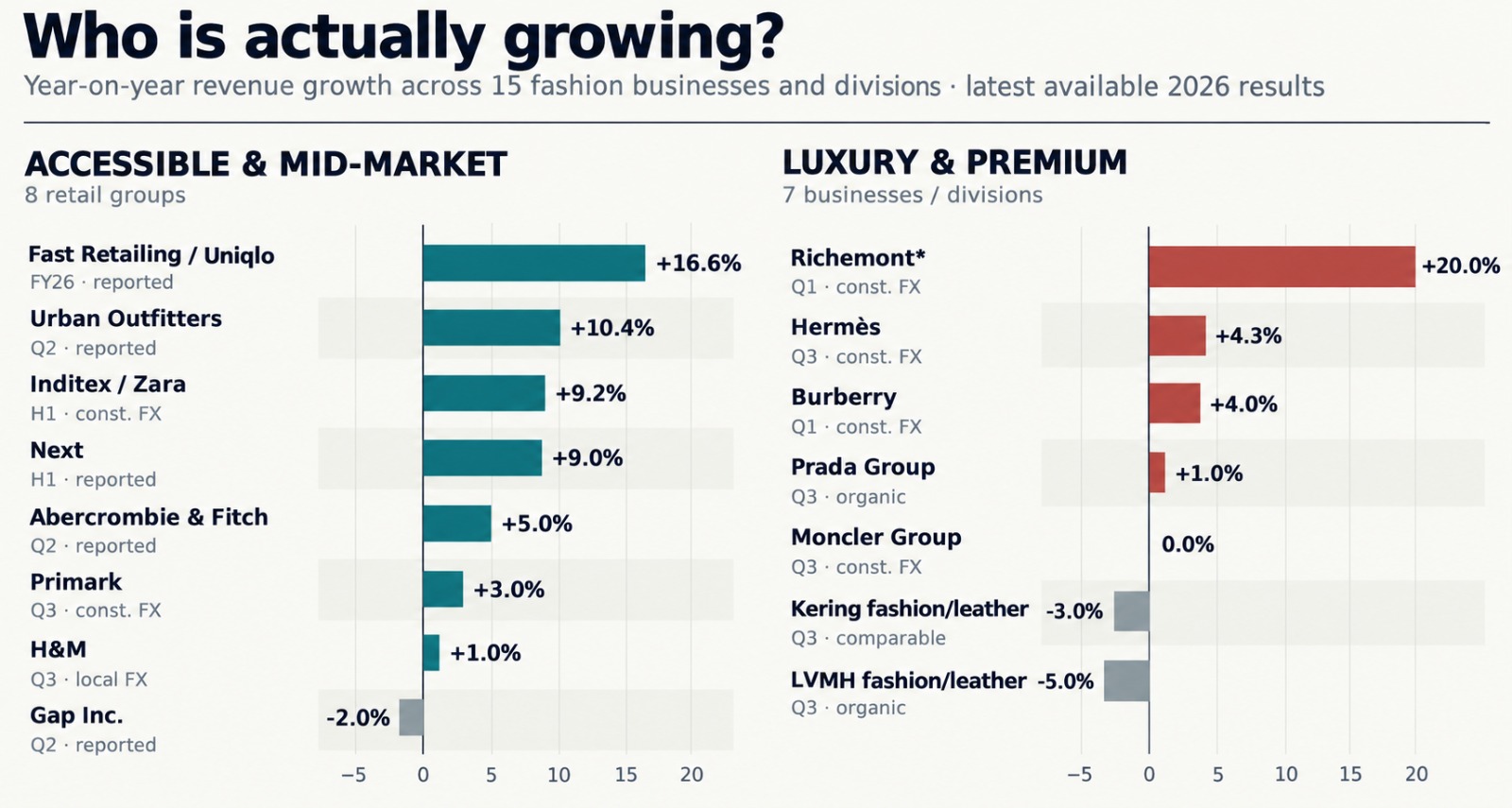 |
The split is not universal: jewelry-heavy Richemont is growing rapidly while Gap is contracting. Sources: 2026 company results – Fast Retailing, URBN, Inditex, Next, Abercrombie, ABF, H&M, Gap, Richemont, Hermes, Burberry, Prada, Moncler, Kering, LVMH. |
What Zara’s smaller footprint reveals
Inditex’s expansion is particularly revealing because it does not depend on opening stores everywhere. Since its 2019 peak, the group has cut its global store count by roughly 27% while reducing selling space by only about 7%. Larger, better-located stores do more of the work, and online demand helps management decide where physical expansion makes sense.
Its next target is the United States. Inditex plans 20 projects there by the end of 2027, including openings, enlargements and refurbishments. Zara is preparing to enter Denver, Phoenix and Pittsburgh, while Bershka and Massimo Dutti, already in Miami, are heading to New York. This is expansion measured in productivity and market coverage, not in storefronts.
Positioning matters just as much. Zara can sell an attractive design without asking the customer to finance a luxury house’s heritage, advertising and exclusivity. For aspirational buyers, that trade-off has become increasingly easy to accept.
H&M’s cost strategy
H&M tells a more complicated story, and an important one. Its sales were flat in local currencies over the first nine months of its fiscal year, and its global store count fell by 95, or about 2%, year over year. No one would call that a retail boom.
Yet operating profit rose almost 12% to 13.5 billion Swedish kronor (about $1.4 billion), and the operating margin widened to 8.3% from 7.1%. The company has concentrated on purchasing, inventory, store upgrades and cost control rather than on physical expansion. Its third-quarter margin also benefited from a one-time effect related to tariffs and goods imports, worth roughly 1.6 percentage points, so not all of the gain should be extrapolated.
What H&M demonstrates is a different kind of strength: an affordable retailer can become more profitable without selling much more. It is a lesson in operational discipline rather than consumer euphoria.
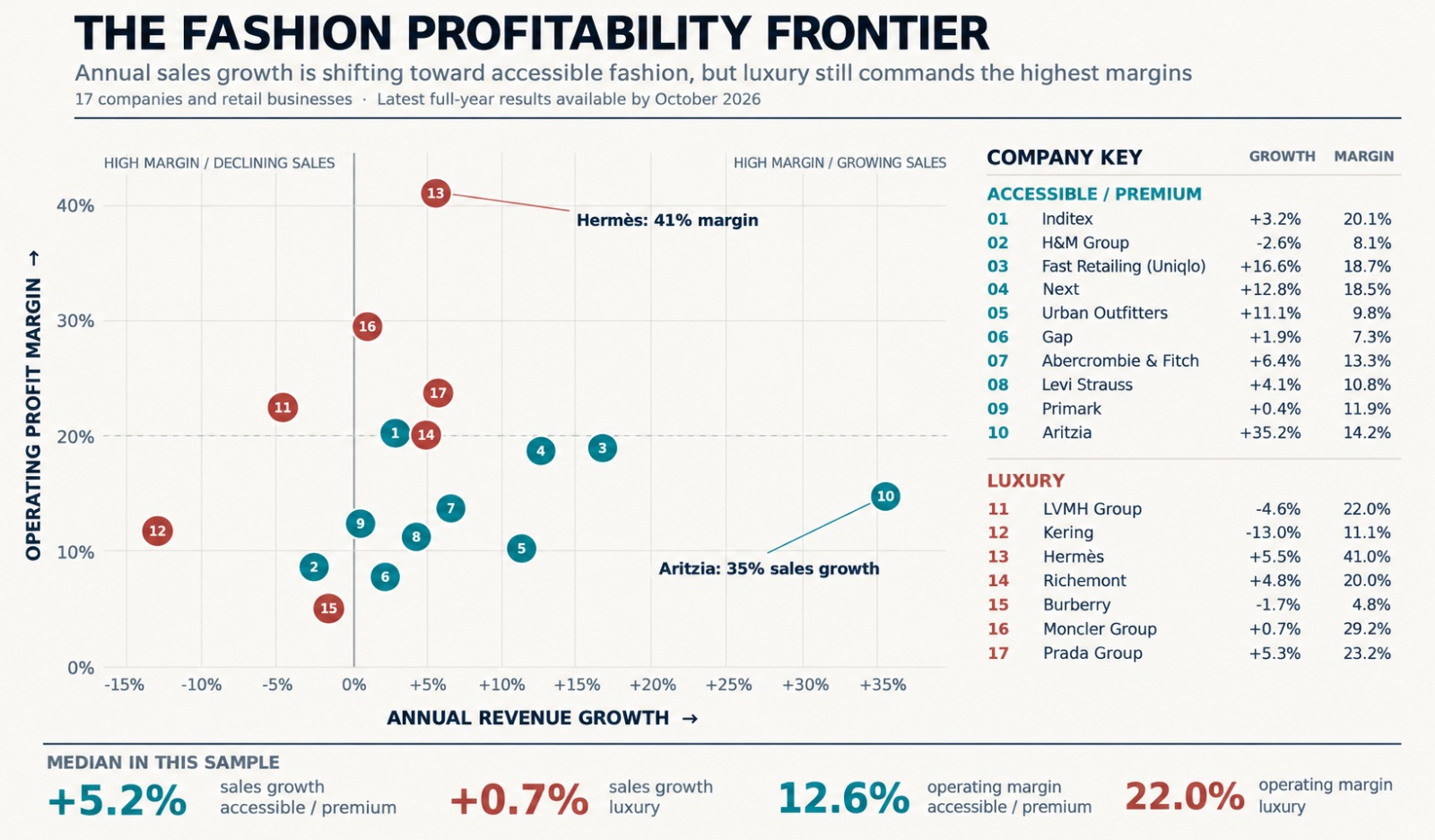 |
Sales growth is reported (not constant-currency). Margins use operating profit, except recurring/adjusted figures where reported by companies. Source: company annual results. |
Price is not the same as value
Bain & Co. estimates that the global luxury customer base shrank to about 340 million people in 2025 from roughly 400 million in 2022. This does not mean those 60 million people all started shopping at Zara. Some stopped buying, some turned to resale, and others traded down to accessible brands. The consequence is the same: luxury’s ambitions now rest on a smaller base of customers.
Three conclusions follow. First, brands have decoupled from their categories: a resilient jeweler and a struggling leather-goods house are not the same investment. Second, store count has decoupled from sales productivity. Third, pricing power should be judged by how much demand survives at a higher price, not by how much management dares to charge.
Luxury, however, is not disappearing any time soon; LVMH remains highly profitable, and exclusivity still has real value. But in 2026, the more compelling growth story belongs to companies that understand what a customer is willing to pay, rather than to those that assume the customer will always pay more.