Diagnosis and Treatment Abroad: The Real Stories of Romanians
In the series "Diagnosis and Treatment Abroad: The Real Stories of Romanians," published on Money.ro in collaboration with tratamentestrainatate.ro, we present today a story about a one-month-old baby, about three extraordinary people and about two days that changed everything.
It is not a story about a long and exhausting treatment. It is not a story about months of uncertainty.
It is the story of a child whose parents had been told had no chance — and who left Vienna, two days later, perfectly healthy.
Poor communication of a diagnosis can be just as devastating as the diagnosis itself. Sofia's story shows why a correct evaluation, done by people with a true calling, changes everything.
From the Money.ro editorial team | Interview conducted with an international medical facilitation consultant from tratamentestrainatate.ro
The phone rang a few days after the child had come into the world.
They were parents. The mother's voice was broken — the kind of brokenness you have when you are holding your child in your arms and someone tells you that child has no chance.
"They told us she has malformations in the brain and the heart. That nothing can be done. What do we do?"
"The Worst Case in the World"
Money.ro: How did you find out about this case?
Consultant: Sofia's parents — I call her Sofia, that is not her real name — had heard that I have connections and direct access to doctors and treatments abroad. They called me desperate, extremely alarmed, not knowing which way to turn.
Sofia was a baby of one month — a month and a little more. Born by caesarean section, premature, somewhere between 32 and 37 weeks. At birth, the Apgar score had been 9 out of 10 — an excellent score, showing good adaptation to extrauterine life.
But in the days that followed, things had become complicated. The child showed difficult breathing, neurological irritability, involuntary movements, periods of hypotonia. Initial investigations had raised questions: a cerebral cyst, cerebral edema, a small periventricular hemorrhage requiring monitoring.
Money.ro: How did the parents reach the conclusion that the situation was hopeless?
Consultant: This is one of the most important lessons of this case — and one I see frequently in my work.
What was communicated to the parents at the local hospital was, most likely, a combination of cautious medical interpretation, overwhelming technical terms and the parents' own fear amplifying everything they heard.
A doctor who says "there is a cerebral cyst requiring monitoring, a small hemorrhage and suspicion of mild encephalopathy" is conveying correct and prudent medical information. A parent hearing these words for the first time, about their child who is only a few days old, can process everything as a definitive sentence.
When they presented the situation to me, it seemed like the worst case in the world. The child had no chance. And, they told me, many other clinics were also unwilling to perform evaluations in this situation.
The Pediatrician with 100% Vocation
Money.ro: What did you do at that moment?
Consultant: I immediately contacted an exceptional pediatrician in Vienna. One of those doctors about whom, when you meet them, you understand immediately that medicine is not a profession for them — it is a calling. A pediatrician with a specialization in pediatric cardiology, with vast experience in complex neonatal cases.
I presented the situation to him. He listened carefully. And, without hesitation, he immediately contacted a colleague — a pediatrician specializing in pediatric neurology. They decided to form a team for this case.
This is the essential difference from a standard consultation: not a single doctor evaluating a file, but a team deciding together from the very first day.
Money.ro: What was established as the first step?
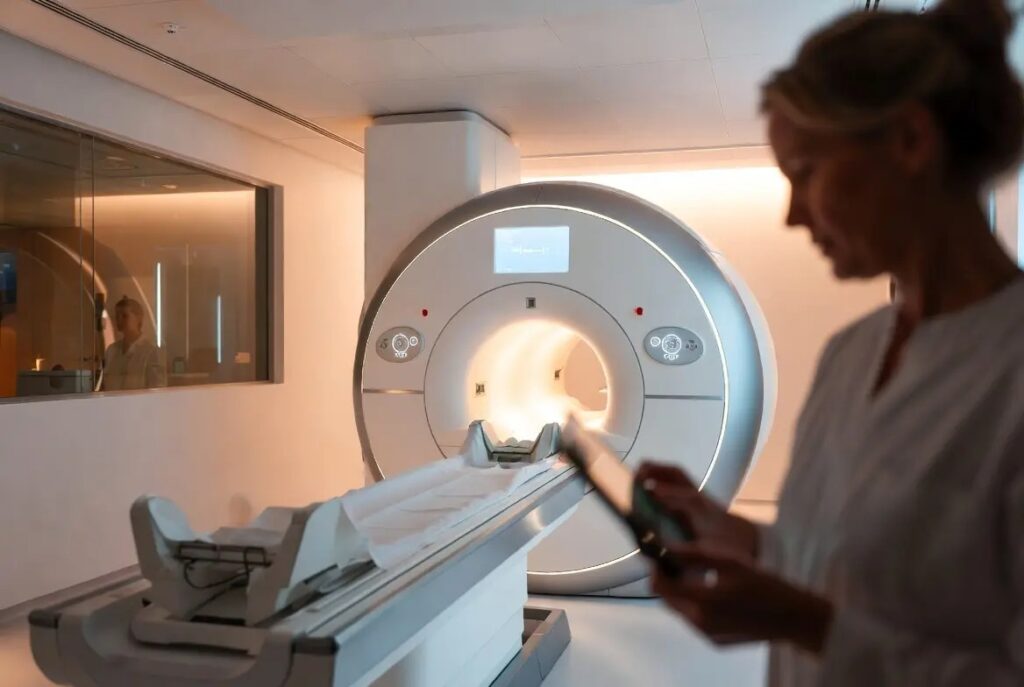
Consultant: A cerebral MRI — the investigation that could clearly and definitively answer all the questions raised by the previous investigations.
The parents brought the child urgently to Vienna, where the investigation had been scheduled.
The Impossible Problem: MRI for a One-Month-Old Baby
Money.ro: Why was the MRI a special challenge for Sofia's age?
Consultant: This is a reality that many parents don't know.
An MRI requires the patient to remain completely still for the duration of the investigation — sometimes 30 to 45 minutes. For adults it is difficult. For a one-month-old baby who cries, gets frightened and moves at the slightest stimulus — it is an enormous challenge.
Without sedation, an MRI on a baby of this age risks being irrelevant — the images are unclear, the movements distort everything and you don't obtain the information you need.
Sedation, on the other hand, is never a decision taken lightly with a newborn.
Money.ro: How was this problem solved?
Consultant: Through ingenuity, patience and, honestly, through something I have not often encountered in my work — the total dedication of a person who thought about this child as if it were her own.
On the case coordination team was an extraordinary woman — I will call her Mrs. T. A mother herself of young children. Involved in this case not just professionally, but humanly, totally.
Mrs. T knew that sedation could not be the solution. And she knew that without a quality MRI, the entire trip to Vienna could be pointless.
So she devised a strategy.
The Strategy with the Skipped Feeding
Money.ro: What strategy did Mrs. T devise?
Consultant: Together with Sofia's mother, Mrs. T carefully observed the child's behavior in the hours before the investigation. She monitored sleep patterns, moments of agitation, the rhythm of feedings.
And she made a simple decision — but one that required boldness and deep knowledge of neonatal behavior: they skipped one of the morning feedings. They kept the child awake for another two hours after she should have been sleeping.
Sofia was hungry. Sofia was tired.
When she was finally breastfed, she fell asleep instantly. Swaddled quite firmly, calm and full, she entered the MRI machine.
Money.ro: How did the MRI go?
Consultant: Mrs. T called me immediately afterward.
She was extremely happy. Her voice radiating — the kind of joy of someone who has fought for something and won.
"The child has discipline! She stayed still for the MRI."
The Result That Changed Everything
Money.ro: What did the investigations show?
Consultant: The MRI result was astonishing.
Nothing from what had been initially evaluated was confirmed at the level of severity that had been suggested. The cerebral images were within normal limits for gestational age. The cyst, the edema, the hemorrhage — all within parameters that did not raise alarm signals at a specialized evaluation.
The cardiac consultation, performed by the pediatric cardiologist on the team, also revealed a good situation. Sofia's heart was fine.
Nothing from the announced catastrophe was real.
Money.ro: How did the parents react?
Consultant: The same type of transformation I have seen in other cases — but every time it impresses me equally.
From the state they had arrived in at the beginning — that the child had almost no chance at life, that nothing more could be done — to the reality in which they were leaving: a child evaluated as perfectly healthy, with a recommendation for routine periodic follow-up and evaluation.
Two days. Three medical professionals with maximum respect for children's lives and for their safe development. And a strategy with a skipped feeding that made everything possible.
Since then, everything has been fine.
What Sofia's Story Teaches Us
Money.ro: What conclusion do you draw from this case?
Consultant: That there are two types of medical crises: the real crisis and the crisis created by poor communication of a diagnosis.
Both are devastating for the family. Both require rapid action. But the solutions are completely different.
In Sofia's case, the initial investigations were not wrong — they identified some signs that needed monitoring, exactly as any responsible doctor should do. The problem arose in communication — between technical medical terms and the understanding of frightened parents with a newborn in their arms.
A specialized evaluation, carried out by a team with real neonatal experience, clarified everything in 48 hours.
What I want you to remember: do not wait to convince yourself that the situation is hopeless. Do not accept that "nothing can be done" before speaking with specialists with direct experience in your child's specific pathology.
Money.ro: What advice do you give a parent who receives a serious diagnosis about their newborn child?
Consultant: To act immediately — and to understand that speed does not mean panic.
A complex neonatal diagnosis, communicated in the first days of a child's life, is often incomplete. Not because doctors make mistakes — but because a premature newborn changes rapidly, neonatal imaging has specific technical limitations, and because the evaluation of a specialist dedicated to neonatal pathology can see completely different things compared to an emergency evaluation.
Seek a second opinion. Quickly. At a center with real experience in neonatology and pediatric neurology.
In Sofia's case, the second opinion cost two days and a trip to Vienna. And it transformed the darkest day in some parents' lives into the first normal day of their child's life.
Call us ☎ 0754 225 262. We analyze the situation. We tell you honestly what and how.
Sofia is a real patient whose identity has been anonymized. tratamentestrainatate.ro is an administrative and logistical facilitation company — it does not provide medical services and does not establish diagnoses or treatments.
Acest articol nu reprezintă consultanță financiară.
Newsletter zilnic money.ro
BET, curs valutar, știrea zilei — în 2 minute, înainte de 7:00.






![[P] Aleze absorbante pentru incontinență: cum alegi produsul potrivit pentru un confort real](/_next/image?url=https%3A%2F%2Fmoney-ro-cdn.sorin-freciu.workers.dev%2Fstorage%2Fv1%2Fobject%2Fpublic%2Fmedia%2Farticles%2F1787897449276-4kv5shig3ns.jpg&w=1920&q=75)